

This week the Women’s National Housing and Homelessness Network joined allies to talk about support for Bill S-206, a guaranteed livable income, in Ottawa’s Senate.
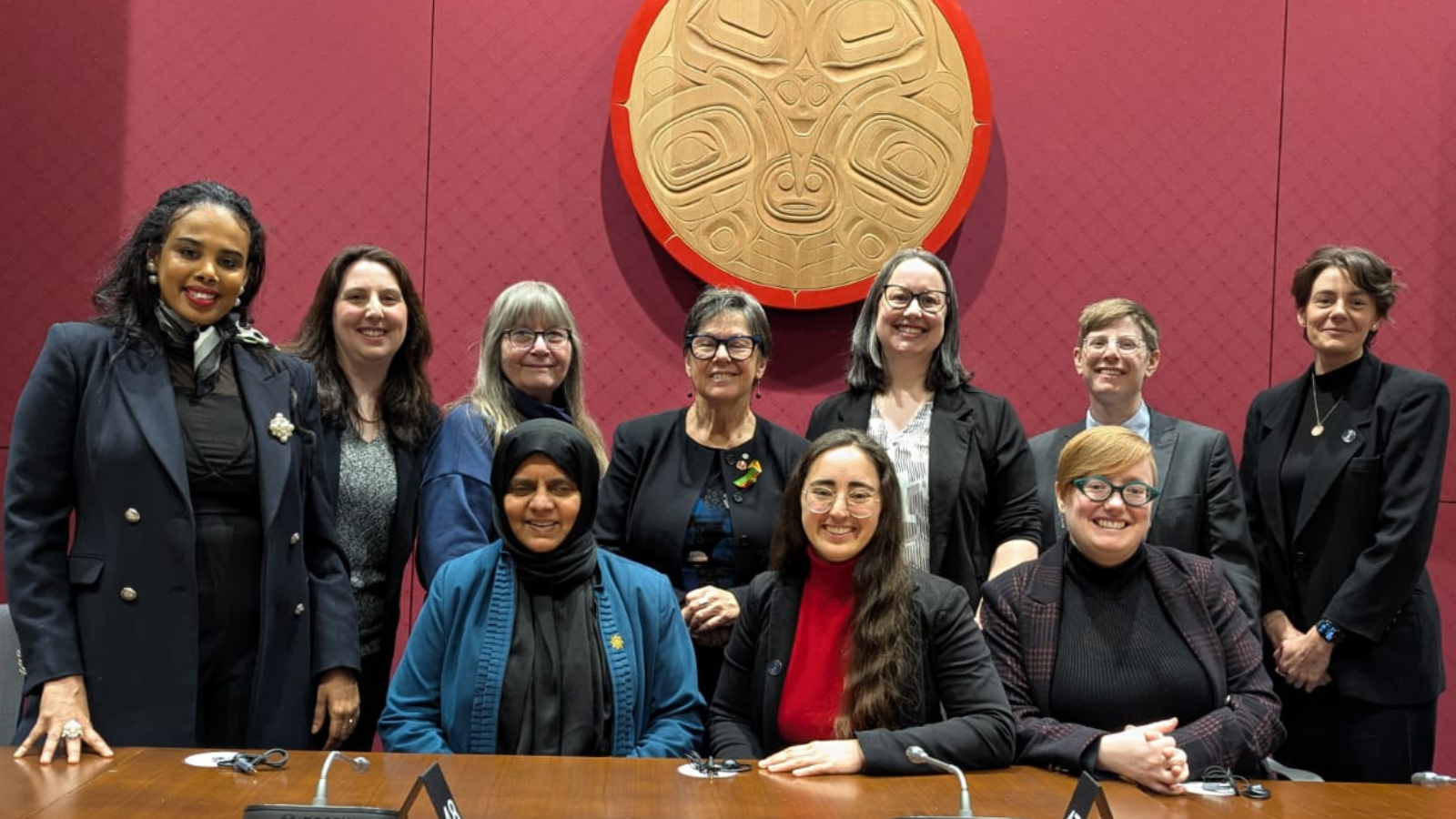 On February 11, the National Association of Women and the Law (NAWL) convened a solutions-focused policy discussion at the Senate in Ottawa on Bill S-206, and the role of a Guaranteed Livable Income in advancing gender justice. The Women’s National Housing and Homelessness Network was among the panelists and spoke to the connection between income and housing.
The other panelists included Senator Kim Pate who is leading Bill S-206; Rabia Khedr, Disability Without Poverty; Arlene Hache, Yellowknife Women’s Society; Cee Strauss, Women’s Legal Education & Action Fund (LEAF); Meseret Haileyesus, Canadian Centre for Women’s Empowerment; and Trish Atlass, Women’s Network PEI/PEI Advisory Council on the Status of Women. Read this brief prepared by NAWL and the panelists: Dignity, Safety, and a Guaranteed Livable Income (en francais).
Read the speaking notes from Stefania Seccia, WNHHN’s Executive Director, Advocacy & Public Affairs:
Thank you for the opportunity to speak today and thank you to Senator Kim Pate for her leadership on Bill S-206.
My name is Stefania Seccia, and I’m speaking today from the perspective of the Women’s National Housing and Homelessness Network, grounded in the realities faced by women, Two-Spirit, trans, and gender-diverse people across Canada whose lives are shaped every day by income insecurity.
For women and gender-diverse people, poverty is not an abstract issue – it is a primary driver of housing precarity and homelessness. Our research consistently shows that women are more likely to experience homelessness in hidden ways: staying in unsafe relationships, couch surfing, remaining in violent situations, or trading sex for shelter because they cannot afford a place to live. These realities are deeply gendered, and they are rooted in structural income inequality, and patriarchal and colonial systems that persist today.
Women, particularly Indigenous, racialized, newcomer women, women with disabilities and gender-diverse people at those intersections, are more likely to live on inadequate and unstable incomes. Existing income supports are often far below the cost of living, punitive in design, and incompatible with safety, autonomy, and dignity. The result is that many people are forced to choose between rent and food, or between safety and survival.
A guaranteed livable income directly addresses these structural harms.
A guaranteed livable income would provide a stable income floor that allows people to meet their basic needs—including housing –without navigating fragmented, conditional, and often retraumatizing systems. For women and gender-diverse people, this stability is not just economic; it represents potential.
Potential for survivors of gender-based violence leave abusive situations. Potential for a young trans person to live independently if they aren’t accepted at home. Potential for a single mother to keep her children if she can afford a home that meets her family’s needs.
Without adequate income, many are forced to remain in harm’s way or face homelessness. A guaranteed livable income would support real choice—the ability to leave violence, to secure housing, and to live with dignity.
The importance of income adequacy is also clearly reflected in the findings of the recent Neha Review Panel. In its examination of the right to housing for women, Two-Spirit, trans, and gender-diverse people, the panel identifies inadequate income as a key barrier to realizing the right to safe, adequate, and affordable housing. The panel explicitly includes guaranteed livable income among its recommendations as a necessary structural measure to uphold housing as a human right.
This is a critical point. Housing policy cannot succeed without income policy that reflects the real cost of living and the realities of people’s lives. Emergency shelters, transitional housing, and crisis responses cannot substitute for economic security. Without adequate income, people remain trapped in cycles of instability, regardless of how many programs may exist around them.
A guaranteed livable income is not a replacement for housing policy or other forms of income supports, but it is a foundation that allows housing policy to work.
For women and gender-diverse people, a guaranteed livable income would reduce exposure to violence, decrease reliance on unsafe survival strategies, and prevent homelessness before it begins. It would support caregiving, recognize unpaid labour, and provide stability for people whose lives do not fit neatly into existing systems.
Most importantly, it aligns with Canada’s human rights obligations. The right to housing cannot be realized when people do not have enough income to pay rent. Ensuring income adequacy is not charity. It is a matter of rights, equity, and justice.
As we consider Bill S-206, we urge decisionmakers to recognize guaranteed livable income as a gender-responsive, rights-based solution that addresses root causes, not just symptoms. A guaranteed livable income is not simply about survival. It is about safety, autonomy and the ability to live in dignity. It presents an opportunity for women, Two-Spirit, trans, and gender-diverse people to realize their own potential by removing oppressive barriers.