

We join the National Right to Housing Network and Canadian Centre for Housing Rights in calling on Canada to meet its human rights obligations under the International Covenant on Civil and Political Rights (ICCPR)
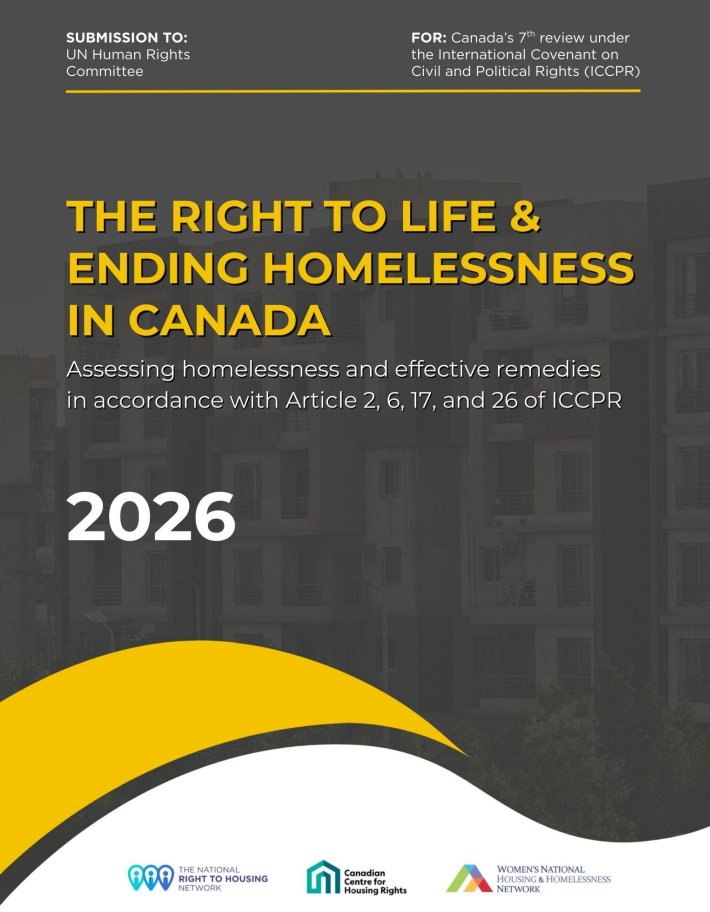 In March 2026, Canada will appear before the United Nations Human Rights Committee for its review under the International Covenant on Civil and Political Rights (ICCPR). Ahead of this review, the National Right to Housing Network, the Women’s National Housing & Homelessness Network, and the Canadian Centre for Housing Rights submitted a joint brief raising serious concerns about homelessness, evictions, and discrimination in Canada.
This submission makes a clear case: homelessness is not only a social policy failure — it is a civil and political rights issue. Read the submission here.
The ICCPR is a binding international human rights treaty that Canada has ratified. It protects fundamental rights such as the right to life, equality, non-discrimination, and access to effective remedies.
While housing is often framed as a social or economic issue, the ICCPR makes clear that civil and political rights cannot be realized when people are forced to live without safe, secure housing. States must not only refrain from violating rights, but must take positive steps to protect them.
Our joint submission aims to ensure that Canada’s housing crisis, and its human rights consequences, are fully considered during the ICCPR review.
It highlights how homelessness, forced evictions, and unequal access to justice undermine rights protected by the Covenant, including the right to life, equality before the law, and freedom from discrimination. It also asks the Committee to clarify Canada’s legal obligations and press for meaningful action.
Systemic discrimination is another core focus. Indigenous peoples, women, gender-diverse people, racialized communities, people with disabilities, and others experience disproportionate housing precarity and homelessness. These patterns are not accidental — they are shaped by structural inequities, financialized housing markets, and policy failures that entrench inequality.
While the submission acknowledges progress, including Canada’s recognition of the right to housing in domestic law, it makes clear that implementation has fallen short.
Rights without timelines, targets, or enforcement mechanisms remain out of reach for too many people.
The submission urges the Human Rights Committee to press Canada to take concrete action, including:
-
Recognizing that the right to life includes a duty to prevent and eliminate homelessness, supported by rights-based strategies with clear goals and timelines.
-
Strengthening legal protections against evictions into homelessness, including access to legal representation and proportionality in eviction decisions.
-
Addressing discrimination in housing, including recognizing homelessness or housing status as a prohibited ground and tackling systemic inequalities that place marginalized communities at greater risk.
Canada’s housing crisis is a human rights crisis. As Canada appears before the UN, this submission makes clear that civil and political rights cannot be separated from housing conditions on the ground. Ensuring safe, secure housing is not optional — it is essential to protecting life, dignity, and equality.
The ICCPR review is a critical opportunity to hold Canada accountable and to reaffirm that housing justice is human rights justice.
Endorsements
Organizations
Abortion Rights Coalition of Canada
Advocacy Centre for Tenants Ontario (ACTO)
BC Poverty Reduction Coalition
Canadian Alliance to End Homelessness (CAEH)
Canadian Center for Women Empowerment (CCFWE)
Canadian Lived Experience Leadership Network
Canadian Union of Public Employees (CUPE)
Disability Without Poverty
EFry Hope and Help for Women
Feminist Alliance for International Action (FAFIA)
HIV Legal Network
Huronia Transition Homes
Intentional Success Corp
International Human Rights Clinic, University of Manitoba
John Humphrey Centre for Peace and Human Rights
Maytree
Peel Poverty Action Group
Quebec Homelessness Prevention Collaborative (Le Collectif québécois pour la prévention de l’itinérance)
Social Housing & Human Rights
South Asian Legal Clinic of Ontario (SALCO)
The NB Coalition of Persons with Disabilities (NBCPD)
The Yellowknife Women’s Society
YWCA Niagara Region
YWCA Toronto
Individuals
Abe Oudshoorn
Arthur Perry
Carolyn Whitzman
Chantal Perry
Dawn Wheadon
Debbie McGraw
Dr. Mary Vaccaro
Floriane Ethier
Francisco Urrutia
Haily MacDonald
Jesse Jenkinson
Meseret Haileyesus
Sarah Buhler
Victoria Boyle
Partner Submissions
Action Canada for Sexual Health and Rights
Canadian Association of Elizabeth Fry Societies
Canadian Drug Policy Coalition (CDPC)
Canadian Feminist Alliance for International Action (FAFIA)
Canadian Feminist Alliance for International Action (FAFIA), DAWN Canada, and Inclusion Canada
John Humphrey Centre for Peace and Human Rights